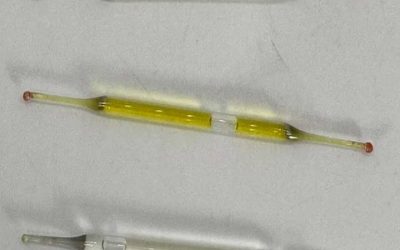
The next morning I immediately went to a private clinic and handed over the sample to a laboratory technician.
A woman in a white coat, her face carved from ancient parchment, accepted the thermos without question. She simply nodded, as if her wives showed up every day with secrets in glass jars. "Results in forty-eight hours, Mrs. Carter. Confidential." Her voice was dry, like the rustling of autumn leaves underfoot. I stepped outside, and San Francisco enveloped me with all its humid, salty weight: the fog clung to my hair like a drowning man's fingers, and the air was thick with the smell of coffee and salt.
The drive home seemed endless. I drove one-handed, gripping the steering wheel so tightly with the other that my knuckles turned white. In the rearview mirror, my face looked unfamiliar: the lines around my mouth deeper than the day before, my eyes the color of a faded sky. For six years, I'd lived in that house like a warm shell: Ethan had filled it with his presence, like a soft light. Now, every step of the stairs rang with suspicion.
He met me in the hallway. Barefoot, wearing a gray T-shirt that clung to his shoulders like a second skin. He smiled, the same smile that once made the world slow down. But today, only my heartbeat slowed, as if my heart had decided to hide.
- You're early, dear. The coffee's already ready.
His fingers brushed my wrist: a light, familiar touch that had once felt like an anchor. Now it burned. I didn't pull my hand away, but I didn't return the smile. I simply nodded, feeling a lump of unspoken questions rise in my throat. He didn't ask me where I'd been. He didn't ask me why I'd avoided his gaze. He simply turned toward the stove, and I heard him softly humming the same tune he'd hummed in the kitchen the day before.
In the bedroom, I sat on the edge of the bed and closed my eyes. Memories of our first year of marriage flashed through my mind: how he would massage my back after yoga, how his breath would brush my neck as he whispered, "little wife." Back then, I thought it was therapeutic. Now, every memory felt like a thin thread woven into a spider's web. What if the drops in the glass weren't poison, but something more subtle? Something that was slowly dissolving my will, my vigilance, turning me into a docile shadow in my own home?
For two days, I lived in limbo. Ethan was impeccable. He cooked dinner: salmon with lemon zest, the scent of which filled the kitchen like warm silk. He read aloud to me from old books I'd loved in my youth. His voice enveloped me, but I found myself listening not to the words, but to the pauses between them, those small silences where the truth seemed to lie. When he offered me a drink that evening, I smiled and said, "I'm alone today, darling. I want to feel... independent." He nodded, but something shone in his eyes—not resentment, no. Something deeper, like the gentle ripples on the surface of a pond, beneath which a shadow was already stirring.
On the third morning, the phone in my bag vibrated. A private clinic. I stepped out onto the balcony, where the ocean wind whipped salty spray into my face, and pressed "accept."
Carter?" The lab technician's voice was flat, almost mechanical. "The test revealed the presence of a substance called phenobarbital. In small doses, but taken regularly. Not lethal. But... enough to induce deep, artificial sleep. And, over time, dependency."
I remained silent. The wind howled in my ears like a distant choir. Phenobarbital. Not poison. Not death. Just a silent velvet cage. Every night: three drops of oblivion. To sleep soundly. To not see. To not ask.
I returned home. Ethan was standing by the living room window, gazing out over the bay. His back was straight as always, but his shoulders were slightly hunched, barely perceptible, as if he'd already sensed a crack in the air. I approached. I didn't touch him. I simply stopped two steps away, and the silence between us became thick, almost palpable.
“Ethan,” I said softly, calling him by his first name without an affectionate suffix for the first time in six years.
He turned. The smile was still there, but his eyes were lost. Something ancient, patient, and infinitely tired shone in them.
- Yes, my dear?
I didn't answer. I just looked. And in that gaze, long and still, like the surface of a frozen lake, I saw for the first time how thin the line is between love and a trap. Between the "little wife" and the woman who has finally awakened.
Outside the window, the tide was rising. The waves crashed against the Malibu cliffs with a dull, rhythmic insistence, like a heart that wouldn't sleep.
Here's the sequel:
I didn't make a scene. I didn't raise my voice. I simply stood there watching until the silence became heavy, like wet silk sticking to the skin.
Ethan was the first to look away. It was a subtle movement, a slight nod toward the window, as if the ocean had suddenly begun to interest me more. But I noticed. That gesture revealed the first crack in his impeccable mask.
"Is something wrong, Lillian?" he asked softly, but his voice no longer held its usual sweetness. Only caution, carefully measured, like those three drops from the amber bottle.
I approached the table and ran my fingers over the polished wood. The surface was cool and smooth, like the surfaces of the tables we'd both spent so much time polishing.
“I know about the drops,” I said calmly, almost nonchalantly.
Silence. A long silence. I could hear the ticking of an antique clock at the back of the house, the very one I'd inherited from my first husband. Each tick was like walking on thin ice.
Ethan slowly ran a hand over his face. The gesture was tired, almost human. For a moment, I saw not a young yoga instructor, but a man carrying a weight too heavy for his age.
"You shouldn't have seen that," he finally said. His voice was low, but unapologetic. "I just wanted you... to sleep in peace."
"Were you asleep?" I allowed myself a small, bitter smile. "Or didn't you notice how you were living in my house, in my life, as if you were in someone else's shoes?"
He approached. Not aggressively. Rather, like a man grasping a fragile vessel about to slip from his grasp. The scent of her skin—a mix of sandalwood and sea salt—was painfully familiar. For six years, that scent had signified safety. Now it reeked of betrayal.
— I love you, Lillian. In my own way.
The word "love" hovered between us like a spiderweb in the corner of an old house: beautiful, but sticky. I felt something tighten inside me, not fear, no. A profound, almost archaeological weariness. How many years had I buried myself alive in this marriage, thinking this was peace?
“Is your love measured in milliliters, Ethan?” I asked.
He didn't answer right away. Instead, he went to the bar and poured himself a whiskey, without ice, in a single gesture that betrayed his habit. The glass shook slightly in his hand. Not much. Just enough for me to understand: he was afraid, too. Not of me. But of what was about to happen.
"At first, yes, I thought about the money," she admitted, staring into the amber liquid. "You were… comfortable. Alone. Rich. But then… then you became real. And I was afraid that if you actually woke up, you'd see me. The real me."
I remained silent. I let him speak. I let each word fall between us, like a drop of water eroding a stone.
"Phenobarbital isn't meant to poison you," he continued, almost whispering. "It's meant to keep you from asking questions. To keep you from remembering how unhappy you truly are. So we can... continue."
Outside the window, the tide had risen. The waves no longer crashed, but roared, crashing onto the shore with a heavy, wet boom. I felt the salt in the air settle on my lips: bitter, alive.
"What now?" I asked.
Ethan put down his glass. He leaned in very close. So close that I could see the fine lines at the corners of his eyes: the first signs that he, too, wasn't eternal. His fingers rose, but didn't touch my face. They remained suspended in midair, trembling.
"You're awake now," he said. There was something new in his voice. Not remorse. Rather, a strange relief. "And I don't know what we'll do now."
I looked at it for a long time. With a studious air. Like looking at a painting you thought was a masterpiece, only to discover another layer underneath: darker, more truthful.
Something changed inside me. Not forgiveness. Not anger. Something quieter and more dangerous: curiosity. For him. For myself. For what would be the next chapter in this strange, fragmented story.
“So,” I said finally, “let’s stop pretending I’m your ‘little wife.’”
I took his hand—for the first time in days—and placed it in my palm. Cold. Trembling.
Let's see what's left when I stop drinking your sleep stories.
Outside the window, the ocean continued its incessant conversation with the shore. And inside the house, in this room, between two people who could no longer hide, something new was beginning.
Something that no longer needed drops to stay real.
Here's the sequel:
—
The ocean outside the window was relentless. It spoke to us in its ancient, profound language: each wave crashed against us with a low, guttural sigh, as if to remind us that nothing remains still, not even lies, not even love.
I still held his hand. The skin was cool and dry, with a barely perceptible tremor in the fingertips. For six years, those fingers had warmed me. Now they felt alien, like an object found in the attic, once yours but now covered in the dust of someone else's touch.
Ethan didn't pull his hand away. He looked at our intertwined fingers as if seeing them for the first time. His eyes, gray-green like coastal stones after the rain, showed no fear. There was something far more complex: a weary awareness. Like a man who has walked the same path for a long time and suddenly realizes it leads nowhere.
"Okay," he said finally. His voice was lower, a little hoarse, as if the words were passing through a channel long unused. "No dripping. No 'little wives.' Just the truth. Even if it turns out to be... uncomfortable."
He said it almost solemnly. And in that solemnity I sensed a challenge. Not to me, but to myself.
We were sitting at the large oak table in the living room. Between us were only two glasses of water and a silence as thick as fog over the bay. I turned on a lamp. The light fell slantwise, illuminating half of his face and leaving the other half in shadow. It was painfully symbolic: that was how I saw Ethan now, half familiar, half unfamiliar.
"Tell me," I said, "from the beginning. Not the beautiful version you've rehearsed all these years. But the one you've hidden behind my soporific nights."
He ran his thumb along the rim of the glass. A slow, hypnotic circular motion. The gesture of a man gathering his thoughts like the shards of a broken mirror.
"I really came for the money, Lillian. At first. You were the perfect target: beautiful, lonely, rich, and... very sad. The sadness in you was deep, real. It won me over. I thought I could play the part for a year, two at most. And then leave with enough money to finally start my life."
He remained silent. Outside the window, a wave was crashing with a peculiar roar against the rocks, raising a white spray.
—But you… you weren't just a target. You listened. You looked at me as if I really existed. Not as a charming young instructor, but as a person. And I began… to grow attached. It was dangerous. Attachment is a luxury I've never allowed myself.
His fingers stopped moving. He looked up.