Inside the box was the golden cake topper.
Twisted. Dry. Clean carefully.
Matteo held it as if it were something fragile and sacred.
"I took him out of the pool after everyone else had left," she told me. "I felt guilty leaving him there."
Then he handed me the envelope.
Inside were several folded sheets of paper, filled with his shaky handwriting and colorful drawings. The first read: "I didn't want to throw the cake, but my dad told me that if I did, he'd take me to the Azteca Stadium and you'd laugh because it was a joke, just like on TV."
My throat closed up.
The next sheet contained a drawing of me standing at an empty table, a gray cloud overhead, while two figures laughed in the distance. Below it, I wrote: "It wasn't funny."
"Why did you write this?" I asked him.
Mateo looked down.
—Because my father kept saying nothing had happened... but something had. And because I apologized to you and he told me I shouldn't feel guilty if you deserved it.
I felt such a strong mixture of anger and sadness that I had to sit down.
I called Paola right away. She arrived twenty minutes later, furious, disheveled, and more worried about the scandal than the fact that her son had traveled halfway across town just to tell the truth. She grabbed Mateo's arm, but before leaving, the boy stepped back for a moment and said to me:
—You were right. They need help.
That same night, I scanned the letters and sent them to the lawyer to add to the file. Then I called Ricardo.
—Did you know your son took the bus just to come visit me? —I asked him as soon as he answered.
Silence.
I told him everything: the box, the ornament, the letters, the confession.
When I talked about the drawing, his voice cracked for the first time in my life.
“I… I didn’t think I’d actually do it,” she muttered.
—No. You just taught him that hurting someone can be fun if you get a reward.
It took Ricardo several seconds to respond.
—I'm going to start therapy. Seriously. But don't shut the door on me because of Mateo.
“I don’t intend to settle this with Mateo,” I told him. “But you don’t know yet.”
I hung up.
In the weeks that followed, I received photos of Ricardo, Paola, and Mateo outside a doctor's office. My mother texted me saying they were "already making the effort." My father asked me if I planned to reactivate the trust fund.
The answer was no.
Not for revenge. As a limit.
I no longer wanted to be the woman who always understood, always forgave, and always came back to sit at the same table where she was torn to pieces.
So I made another decision.
Months earlier, I'd spotted a rental listing in a small town on the Baja California coast. A simple house near the cliffs, smelling of salt, with sweet bread on the corner and a small bookstore where no one knew my last name. I applied without thinking twice.
They gave it to me.
On moving day, I carefully packed the cake decoration among my things, a care I didn't even understand. Perhaps because it was no longer a reminder of the humiliation, but proof of that night when I'd stopped pretending everything was fine.
Before boarding the plane, I sent Ricardo one last message:
"You spoke of inheritance as if it were money, property, and surnames. But the true legacy is what we leave in the lives of others. You taught your son to humiliate. I hope to teach him something else. Thank him for telling the truth. He was the bravest of all."
I turned off my cell phone.
The coast slowly changed me. I started taking ceramics classes, learned the basics of carpentry, and made friends with people who knew me only as the woman who always ordered a concha and a black coffee at the pastry shop. No one asked me when I was getting married. No one made me feel incomplete. For the first time in a long time, the silence didn't oppress me.
Mateo continued to write me letters.
In one of them, she wrote: "I didn't know what legacy was before. Now I believe it's what people feel when they remember you. I want them to remember me for being a good person."
I stuck that letter on my refrigerator.
I haven't unlocked the trust fund yet. I don't know if I ever will. True change isn't demonstrated with a photo outside of therapy or a speech of repentance. It's demonstrated with time, perseverance, and the truth. And if Ricardo ever knocks on my door to truly apologize, without mockery, excuses, or hiding behind his son, I'll see what I can do.
But I don't wait for that moment to live.
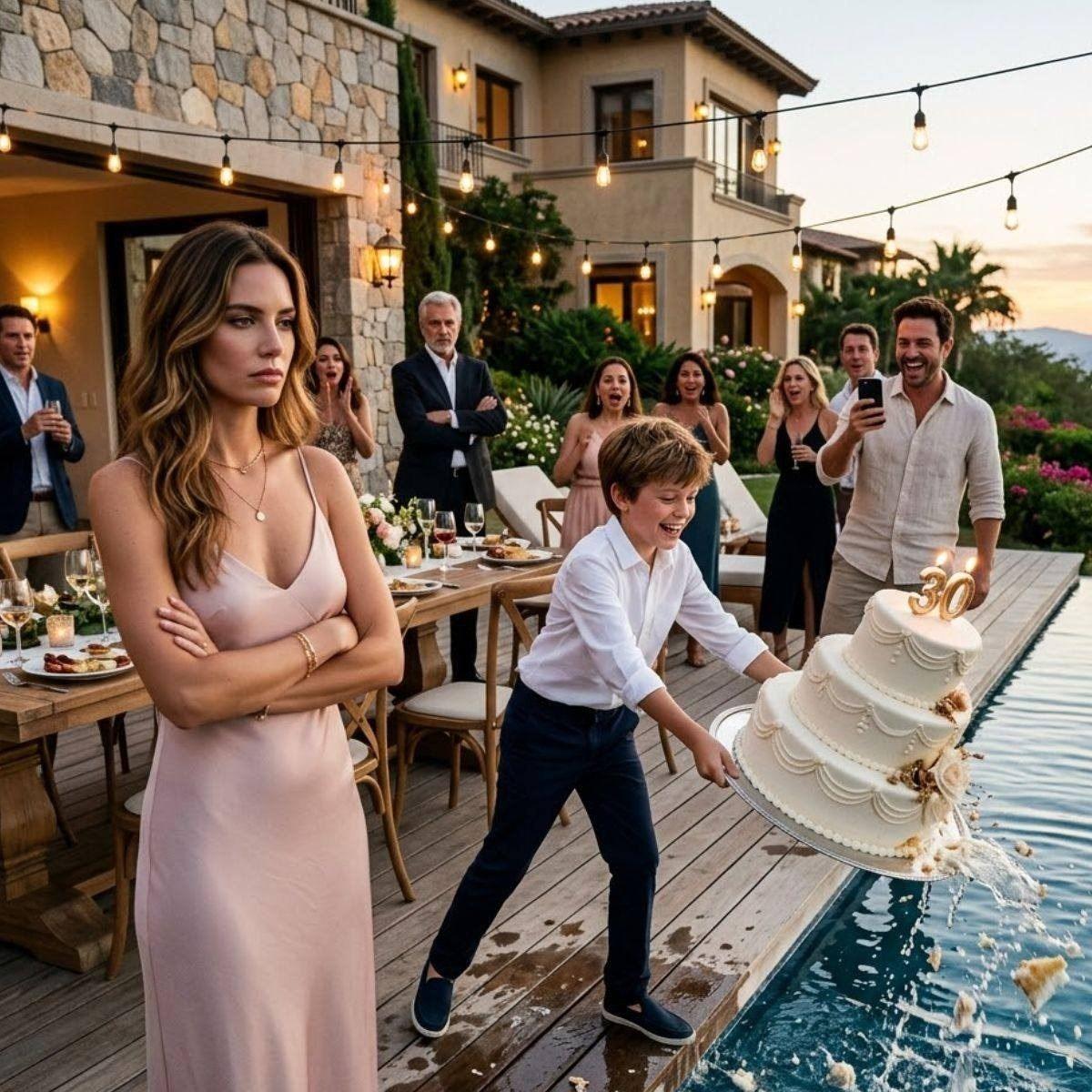
Because my life didn't end the night a cake fell into the water.
That night it all began.
And if you asked me today what legacy I would like to leave, I certainly wouldn't say a house on the lake or a bank account.
I would like to bring to your attention a letter written by a ten-year-old boy who learned too early that even inherited cruelty can be broken.
I want to emphasize the peace I have built away from those who forced me to shrink so they could feel important.
And now I'm going to tell you something that took me thirty years to understand:
Sometimes, the bravest thing to do is not to stay and fight for a seat at the table.
Sometimes, the bravest thing to do is to stand up... and walk away forever.