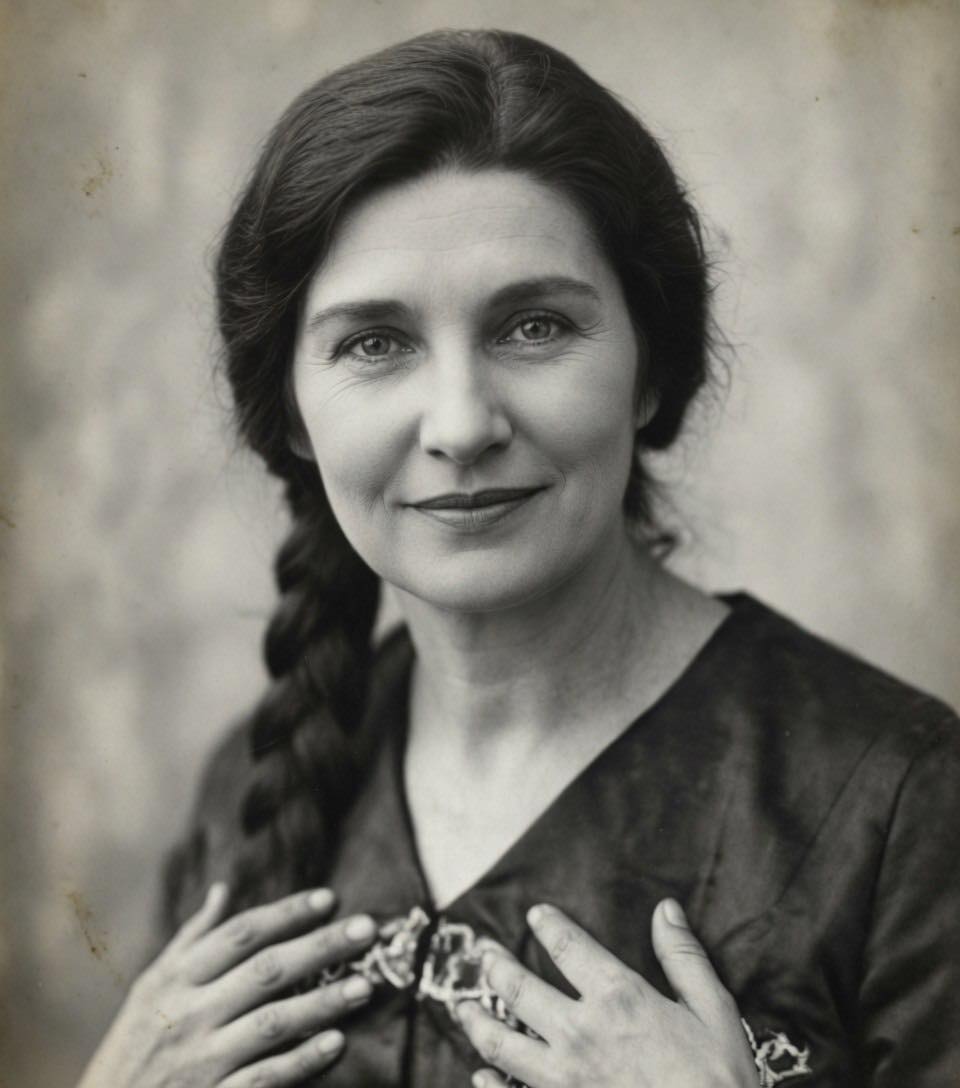
Taisiya nodded silently, and there was no trace of girlish shyness in her gesture, only that same stern concentration that had made her seem so "odd" in the village. She stood up, without moving a single corner of her skirt, and headed for the door. The floorboards beneath her felt boots didn't creak, as if the hut itself were holding its breath. When the door closed behind her, only a heavy, oppressive silence remained in the room, permeated by the smell of kerosene from the lamp and the bitterness of bootleg liquor still lingering in the air from the office.
Yevsey Panteleevich didn't look up. He sat hunched, elbows on his knees, and his fingers, broad and cracked from incessant work with iron and wood, opened and closed slowly, as if kneading an invisible lump of clay. The rage that consumed him was no longer raging: it had subsided, transformed into a cold, heavy ingot. The same kind of ingot they forged in the forge outside the village. He wasn't thinking of filial honor, no. He was thinking of how tomorrow Inspector Stupin would show up at the council office with his briefcase, how the barn would smell not only of grain, but also of his own skin, stretched for a court. And behind it all: his son in Leningrad, writing him letters about a "new life," and Uliana, whose braid now fell over his shoulder like a heavy, dark snake.
Uliana didn't cry anymore. She sat there, head bowed, needle poised over her embroidery: the red rooster on the towel was left unfinished, one eye empty. Something tightened in her chest, like a rusty lock on an old trunk: her love for Plato wasn't tender, but tenacious, like the roots of milk thistle in the black earth. She knew about the carts. She knew about the gold that jingled in his pockets at night. And she remained silent, because his words about the great city contained more than simple lies: they contained the promise of escape from that hut, where even the air smelled of foreign bread.
"Ulka," her father said softly, barely making a sound, without raising his head. "You weren't just silent. You covered for him."
She didn't answer. Her fingers merely trembled, and the needle pricked her skin. A drop of blood appeared, bright as a berry in the snow, but Uliva didn't flinch. The sting was nothing compared to what was unleashing inside her: the fear that Plato was somewhere along the road, an accordion slung over his shoulder, unaware that he was no longer expected as a stablehand, but as a wolf in a sheepfold.
Taisiya didn't return alone. Zakhar, the paramedic, followed her: a tall man in a worn sheepskin coat, carrying a bag full of clinking bottles. Behind her, shuffling, came Grandma Manya, the postwoman, her bright little eyes sparkling with eager curiosity, but, as she'd been told, she kept her mouth shut. No one asked why. Everyone knew: in town, trouble doesn't travel alone; it comes in droves.
"We'll be ready, Evsey Panteleevich," Zakhar murmured, placing his bag on the doorstep. "Heart, blood pressure... you never know."
Grandma Manya simply giggled, sitting on a bench in a dark corner and rummaging through old envelopes in her pocket, as if that would calm her. A new scent filled the hut: medicinal, pungent, like the chilly air after a sauna. Taisiya didn't sit down. She remained standing by the window, gazing out into the night, where the moon hung low like a cracked silver ruble. There was no fear in her eyes, just the same concentration as before. As if she had already seen how it would end and was preparing for the next chapter.
The night dragged on, like molasses from a broken hive. No one went to sleep. Yevsey locked himself in the office, where the empty, faceted stack still lay on the table, and the cards with the numbers now seemed alive: they moved beneath his fingers like guilty verdicts. Ulyana and Taisiya remained in the living room. The sisters sat side by side, but a gulf wider than Zaozerye separated them. Ulyana twisted her braid, wrapping it around her finger, as if trying to mend the broken threads. Taisiya simply stared into the darkness, and there was something heavy, unspoken in her silence, as if she saw not only the carts near the barn, but also what had been before, before Plato, when her father had angrily threatened to give Ulyana to the widowed blacksmith, the very one who lived beyond the Burnt Forest and whose name was spoken with respect and apprehension in the village.
In the morning, the sky was gray, like unwashed linen. The creaking of the cart could be heard in the distance, heavy, tense, as if fate itself were navigating a bumpy road. Plato entered the room with confidence, as always: majestic, with an accordion slung over his shoulder and a bouquet of wildflowers in his hands, already wilted from the passage on the road. His smile was broad, but a shadow was already lurking at the corners of his eyes, as thin as a spiderweb in an attic.
"Matchmaker! Ulyanushka!" he began cheerfully, but his voice trembled when he saw their faces. Yevsey sat at the table, motionless as a forged anchor. Ulyanushka turned toward the stove. Taisiya stood aside, straight as a candle before an icon.
Yevsey didn't get up. He simply raised his heavy, leaden eyes and said in a low, almost tender voice:
"Sit down, Platon Savelyevich. Our conversation won't be about the wedding. Or the grain. Or the night wagons. Or how you, blue-winged dove, have decided that President Zhilin is a blind mole in his hole."
Plato froze in the doorway. His hand instinctively fell on the accordion, his fingers clutching the strap, as if seeking a last hold. The room smelled of ozone, the same smell that precedes a storm, when the air thickens and becomes difficult to breathe. Uliana didn't move, but her shoulders trembled, as if something inside her had snapped, silently, soundlessly, like a dry branch under the first snow.
Taisiya looked at her sister's fiancé not with hatred, but with the same cold intensity with which she observed the night shadows near the barn. And in that gaze, in that silence that hovered between the four, a new, as yet unspoken truth was already ripening: the village would soon repent, taking pity on the "poor lamb," while the iron man, spoken of from the beginning, was already there, somewhere beyond the Burnt Forest, forging his destiny silently and confidently, as one forges a horseshoe.
Plato didn't sit down. He remained standing in the doorway, as if that final boundary were the last line he could still avoid crossing. The accordion on his shoulder suddenly felt like a heavy, useless piece of iron, and the wilted flowers in his hand felt like a pitiful offering to fate. The air in the room thickened, warm and dense, like steam on freshly baked bread, only instead of the scent of rye crust, it was pervaded by the cold taste of metal and an ancient fear.
"Yevsey Panteleevich..." he began, and his voice, always so clear, now sounded hoarse and scratchy, as if cut with a rusty file. "You've got it all wrong. Supplies, wood, people... I wonder what they're talking about."
He tried to smile, the same smile that had once melted Ulyanina's heart, but his lips twitched slightly, revealing strong teeth, and the smile came out wolfish, almost hunting. His eyes darted toward Ulyanina, seeking her familiar support, but she was sitting with her back to him, and only her heavy braid trembled slightly, as if she were alive.
Taisiya took a step forward. Not abruptly, but delicately, almost silently, like the shadow of a cloud on water. There was neither triumph nor malice in her movements. Only the same calm, almost medically attentive, with which she once read old books on illnesses and fractures, as if she could already foresee exactly how this man would break.
"I saw it, Platon Savelyevich," she said softly, but each word sank into silence like a stone in a deep well. "More than once. And not just the cart. I heard you and Ignat counting gold coins at the old apiary. The gold jingled. Softly, but I heard it. It sounds different from the grain."
Yevsey rose slowly. His imposing figure, as if carved from a block of solid oak, blocked the window, and the room grew darker. He didn't shout. His voice was low, almost gentle, and this gentleness made Plato shiver, colder than an April frost.
"So, I don't understand... But tell me, my dear friend, how many quintals have ended up 'secretly' in these months? How much of my skin have you already sold to gold miners?"
Plato took a half step back. His shoulder brushed the doorframe, and the accordion tinkled mournfully: a single bass note, muffled like a funeral bell. At that moment, Uliana finally looked up. Her eyes were dry, but they expressed such desolation that even Grandma Manya, in the corner, stopped sorting the envelopes. She looked at her fiancé, and in that gaze, love hadn't died, it had simply transformed into something else: a heavy, dark burden that now lay at the bottom of her soul like a sunken anchor.
"You promised..." she whispered. "A city. A new life. And you... you and my father were taking me to a monastery."
Plato opened his mouth, but instead of words, only a hoarse breath came out. He understood: neither the accordion nor the sweet words could save him. What awaited him was not judgment, but something far more terrible: the harsh truth of the village, slow and inexorable, like the passing of the seasons.
Suddenly, he turned sharply toward Taisiya. A flash of aggression, almost predatory, flashed in his eyes.
"And you, fool... you've always spied on everyone, haven't you? You read their books and looked for their weaknesses. Maybe you were jealous because you weren't the one invited to town?"
Taisiya didn't look away. She simply raised her chin slightly, and that gesture emanated such silent power that even Yevsey froze for a moment. She didn't respond with words. She simply looked at him as if she could already glimpse his future: not in the big city, but in a distant place, between the taiga and the stages, where the sound of the accordion quickly fades.
At that precise moment, a new sound was heard outside the window: the heavy footsteps of several people and the soft barking of a dog. Yevsey nodded to himself, as if he had been expecting it for a long time.
"Ignat's already at the blackboard," he said calmly. "And Inspector Stupin just arrived. Not alone. With witnesses."
Plato dropped the flowers. They fell to the floor as silently as autumn leaves. He no longer tried to smile. His face turned gray, like an old canvas from which someone had erased all the colors.
Ulyana stood up. She approached her father, but didn't hug him: she simply stood beside him, shoulder to shoulder. That gesture was both forgiveness and farewell. Taisiya remained aside, by the window. She wasn't looking at Plato, but somewhere beyond, beyond the Burnt Forest, where, it was said, that widowed blacksmith lived: silent, strong, with hands accustomed to red-hot iron and even more burning secrets.
And in this silence, permeated by the smell of kerosene, dust, and the approaching spring, a new, still unformed, realization was already dawning: the village would truly regret itself. But not out of pity for the "poor little lamb." But because the iron man, whom everyone had neglected, had suddenly appeared closer than he seemed. And his silence was far more eloquent than any accordion.
The door opened. The witnesses entered.
And behind them, a completely different story began to unfold slowly but inexorably, like a cold skein.
And then she entered—a very different story. Not with a crash and shouts, but with a low, almost ceremonial creak of the door and the smell of a damp spring wind that blew into the hut along with the people. The witnesses—two grim-looking collective farmers from a nearby brigade and Comrade Stupin himself, the inspector, in his city overcoat, too light for the local morning performances—filled the room with a dense, oppressive presence. The air immediately became suffocating, like in an old trunk where winter clothes had been left too long.
Plato didn't resist. He simply remained still, slightly hunched, staring at a precise spot on the table where Uliana's unfinished embroidery had lain the day before. His arms hung at his sides, his fingers trembling slightly, as if he were still playing the invisible strings of an accordion. That silence contained everything: the knowledge that words would no longer save him and a strange, almost relieved, resignation to the inevitable. He didn't even spare Uliana a glance. As if he were afraid of seeing in her eyes what could no longer be undone.
Yevsey Panteleevich spoke little. Only briefly, in heavy sentences, like hammer blows on an anvil. Stupin nodded and jotted notes in his notebook, but his gaze continued to rest on Taisiya, with mild surprise, as if he hadn't expected to find such concentrated, almost adult attention in the eyes of a seventeen-year-old girl in that hut. Taisiya stood by the stove, her arms crossed over her chest, her gaze fixed on him. Not on Plato, but on her father. Her silence conveyed more than simple support. There was something deeper: a quiet, almost scientific curiosity about how a person breaks from within when a carefully constructed lie collapses.
Ulyana went out into the courtyard as the witnesses began taking their statements. She wasn't crying. She simply stood beside the well, her palms resting on the cold, dew-damp trunk. The water below seemed like a black mirror, reflecting the gray sky and her own face: pale, with deep circles under her eyes. Her braid hung heavily down her back, like a chain. Inside her, the love hadn't turned to hate; it had simply settled to the bottom, thick and still, like silt in an old pond. Now it was empty and silent. So silent that you could hear the water dripping from the edge of the well, slowly, steadily, as if it were marking the remaining moments of her previous life.
Taisiya followed her. She didn't approach, but stopped two steps away, giving her sister space. There was always this distance between them, invisible but strong, like a tight rope.
"He really wanted to take you to the city," Taisiya said softly. Not to console you, but simply to assess the situation. "But that city would have been a gilded cage for you. Here, however... at least here you have your own air."
Ulyana slowly turned her head. Something new flashed in her eyes: not gratitude, not resentment, but a sudden, acute awareness. As if for the first time in years she had truly seen her younger sister. Not the "extravagant Taiska," always book-toting, but someone who had long lived in this world according to its own, more rigid and precise rules.
"And you... where does all this come from?" Ulyana asked hoarsely. "How can you see all this?"
Taisiya shrugged, almost imperceptibly, like a man.
"When you read about people who died long ago, you begin to see those around you better. They, too, are made of words. They just rarely say them."
Meanwhile, in the hut, Stupin was finishing up. Plato was already being led out, uncuffed, simply by the arms, like an ordinary person who was suddenly no longer considered one of them. He passed Uliana without looking up. His shoulder brushed hers, and that casual touch was more of a farewell than any words. The accordion remained there, on the bench inside, forgotten, a silent rebuke.
As the wagon carrying the witnesses and the arrested man disappeared around the corner, Yevsei Panteleievich stepped out onto the veranda. He stood there for a long time, breathing deeply in the frigid air, thick with the smell of melting snow and chimney smoke. His face was impassive, but fine lines had formed at the corners of his eyes, not from tears, but from that weary, senile wisdom that comes to a man who has almost lost everything.
“Taisiya,” he called softly.