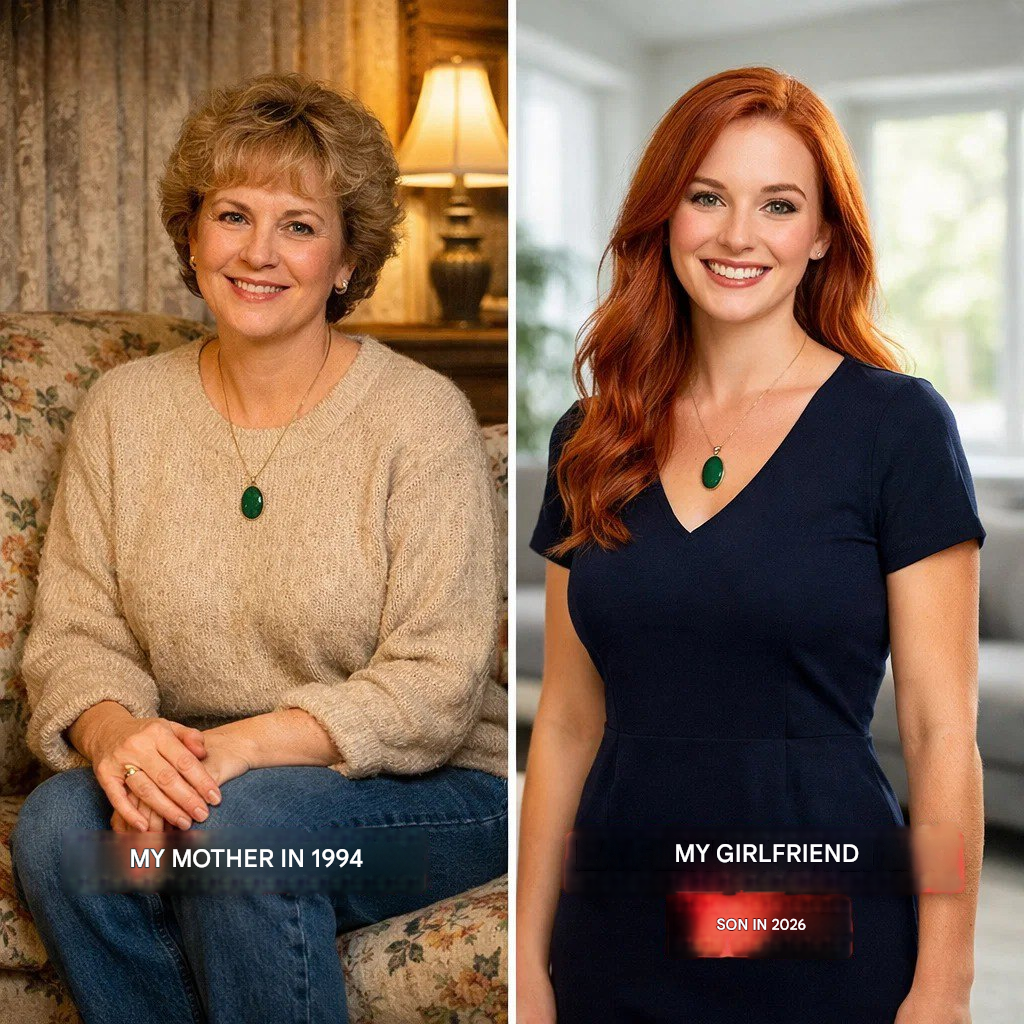
I watched him as I carefully, almost ceremoniously, removed the photos one by one. Then I arranged them horizontally between us.
He looked down.
The change in him was immediate, yet subtle: a twitch at the corners of his mouth, a labored breathing, his shoulders stiffening as if he had received a pat on the spine.
He took a photo, stared at it, then put it down.
I took the second one. I stared at it longer.
His fingers were shaking, just a little, but just enough for me to notice.
Then he put that down too and clasped his hands together, as if by remaining still he could stop time.
I said nothing. I let the silence deepen, because silence has the power to bring out the truth.
Finally, Richard cleared his throat. "Who is it?"
“My mother,” I said. “Her name was Evelyn Parker.”
Richard's jaw tensed. "And the necklace?"
“You know what the necklace is like,” I said softly.
He leaned back slightly, glancing at my face. "This is ridiculous."
I smiled, just a little. "Really?"
Her voice rose. "Claire's necklace..."
"It's my mother's necklace," I interrupted. My tone remained calm, but it hardened like solid ice. "I buried it with her twenty-five years ago. I put it in the coffin myself."
Richard's eyes flashed: annoyance, fear, something else.
“It’s impossible,” he said.
I nodded. "I thought so."
He exhaled calmly. "There are similar pieces."
“There aren’t any,” I said.
His gaze deepened. "How do you know?"
Because I opened it.
Because I felt the zipper.
Because I would recognize that internal engraving even in the dark.
But I didn't need to explain myself to a man whose first instinct was to hang up on me.
"I can go to the police," I said, letting the words fall like a weight on the table. "Or you can tell me where you got it."
This upset him.
Richard's gaze flicked to the door, then back to me. His throat moved once.
He let out a slow breath, the kind you hear before a man finally stops pretending.
“I didn’t steal anything,” he said softly.
I didn't bat an eyelid. "Then tell me."
He stared at the photos again as if my mother's face had power over him.
Then he spoke.
“Twenty-five years ago,” Richard said, “a business partner proposed it to me.”
I felt a knot in my stomach.
He continued: "He said it had been in his family for generations. He said it was known to bring extraordinary good luck to anyone who carried it."
I remained still, with my hands clasped in my lap to keep them from shaking.
Richard swallowed. "My wife and I have been trying to have a baby for years. Years. Doctors, tests, treatments... everything. Nothing worked."
His voice cracked slightly on the last word, then stiffened, as if he hated letting emotion show in his story.
"He said it could help," Richard continued. "I don't... normally I don't believe in such things. But desperation makes one stupid."
I didn't interrupt.
"I paid him twenty-five thousand dollars," Richard said, his eyes fixed on the table. "Cash. No ID."
Of course, there was no documentation. That would have made the truth too easily traceable.
“And Claire?” I asked softly.
Richard clenched his jaw. "Claire was born eleven months later."
The words hung in the air like smoke.
He looked at me, his eyes hard. "Since then, I've never questioned anything. Not once."
I held his gaze. "Because it worked."
He didn't answer, but the silence was enough.
“Name,” I said.
Richard's brow furrowed. "What?"
"The man who sold it," I said. "I want his name."
Richard hesitated again. Then he said, "Dan."
The room tilted.
Not because the name was shocking in itself.
Because it was a name I knew so well that it had entered my bones.
Dan.
My brother.
I stared at Richard, waiting for him to correct himself, for him to laugh, for him to say he meant Don or Darren or something else.
He didn't.
“Dan,” he repeated, his voice lower now, as if sensing he had hit a sensitive spot.
My throat went dry. "Dan who?"
Richard's eyes narrowed. "I never knew his last name. He was a partner in a small investment firm for a few years. It didn't last long."
My heart was pounding in my ears.
A sick, cold understanding began to dawn on me, but my mind resisted it.
My brother had been to my mother's funeral.
My brother hugged me when I cried.
My brother had seen me put that necklace in the coffin.
Except that…
Unless you did.
I swallowed hard. "What did he look like?"
Richard described him with short, testy comments: medium height, graying hair, a ready smile, the kind of man who spoke with ease.
It was there.
Too good.
I forced myself to breathe through my nose.
I slowly collected the photos and put them back in the envelope.
Richard looked at me suspiciously. "What are you going to do?"
I got up.
“I’m going to talk to my brother,” I said.
Richard's face darkened. "This has nothing to do with Claire."
I paused, anger boiling inside me. "Claire has everything to do with this. My son is going to marry your daughter. That necklace will remain on my table for the rest of my life, unless I figure out exactly what kind of poison brought it here."
Richard flinched.
I headed for the door.
“Mrs. Parker…” he began.
I turned around, my voice thinning like a knife. "If you hang up on me again," I said, "I'll involve the police, the press, and anyone else who might be interested in the story of a necklace stolen from a coffin."
Richard's face went pale.
I left without saying a word.
I drove to my brother's house without stopping once.
My hands were so tight on the steering wheel that my knuckles hurt.
My thoughts were wandering uncontrollably, bouncing off each other as if trapped in a box.
NO.
It's not possible.
Dan wouldn't do that.
But beneath those protests lurked a quieter voice, a voice that had always known my brother was capable of selfishness.
Dan had always been charming, the way people are when they want something. He always had an excuse. He always had a story. He always had a way of making you feel like you were overdoing it.
When I pulled up to his driveway, the television was on so loud I could hear it even through the closed windows.
I knocked.
He opened the door with a smile already plastered on his face, as if he had been practicing for years.
“Maureen!” he thundered. “Come in, come in.”
He hugged me before I could speak. His arms were warm. Familiar.
I felt like pushing him away.
"I wanted to call you," Dan said cheerfully, letting go of me just enough to look me in the face. "I heard the good news about Will and his lovely companion. You must be over the moon, right? When are you getting married?"
I let him talk.
I entered.
Her house smelled of microwaved food and stale coffee. The television was blaring in the living room. A pile of laundry lay on the couch.
Normal. Ordinary. My brother's disastrous life.
Dan continued talking as he led me to the kitchen, still acting the enthusiastic uncle as if it were an automatic gesture.
I sat down at his kitchen table and placed my hands flat on the surface.
Dan's voice slowed mid-sentence.
He realized that something was wrong.
“What’s going on?” he asked, pulling out the chair in front of me.
I looked at him and felt twenty-five years of family history tighten like a rope.
“I have to ask you something,” I said, with a calmness that frightened even me, “and I need you to be honest with me, Dan.”
His smile twitched.
“Okay,” he said, still trying to sound casual. “What’s going on?”
I didn't sweeten it. I didn't introduce it gradually.
"Mom's necklace," I said. "The green stone pendant she wore all her life. The one she asked me to bury with her."
Dan blinked.
“What is it?” he asked, but his voice had become cautious.
I watched his face as if it were a confession engraved on his skin.
“Will’s girlfriend wore it,” I said.
Something moved behind his eyes.
A flash. A snap.
He leaned back and crossed his arms: a defensive, automatic posture.
“That’s not possible,” Dan said. “You buried him.”
"I thought I did," I said softly. "Then tell me how it ended up in someone else's hands."
Dan's throat moved up and down.
“Maureen,” he said, forcing a laugh, “I don’t know what you’re talking about.”
"Your father told me he bought it from a business partner twenty-five years ago," I said. "For twenty-five thousand dollars. The man told him it was a good luck charm that would last through the generations."
Dan's eyes widened before he could stop them.
“Wait,” he whispered, astonished. “Claire’s father?”
"YES."
Dan's mouth opened, then closed.
He stared at the table as if it might offer him an escape route.
I kept my eye on him. "He told me the man's name."
Dan didn't speak.
His lips tightened. His shoulders hunched slightly.
At that moment, he looked less like my fifty-year-old brother and more like the idiot teenager who got caught stealing beer from the garage and swore he hadn't done it, despite the empty cans under his bed.
"He was going to end up in the ground, Maureen," he finally said, lowering his voice. "Mom wanted to bury him. He would have disappeared forever."
My stomach turned.
"What did you do, Dan?"
He ran a hand over his face, and when he spoke again, his voice sounded expressionless.
“I went into Mom’s room the night before her funeral,” he confessed, “and replaced it with a replica.”
I stared at him, feeling a hollowness in my chest.
"I heard her ask you to bury him with her," he continued, the words now pouring out of him. "I couldn't believe she wanted him buried."
I clenched my hands into fists on the table.
“You stole from Mom,” I said softly.
Dan winced. "I had it appraised," he said desperately, trying to justify himself. "They told me how much it was worth, and I thought... I thought it was a waste. That at least one of us should get something out of it."
My voice cracked. "Mom never asked you what she wanted. She asked me."
Dan couldn't answer this question.
He looked down, the shame finally showing through.
I let the silence settle between us, heavy as dust.
When Dan finally spoke again, his voice was lower.
“I’m sorry,” he said. “Really.”
No excuses. No "but you have to understand." Just a sincere apology.
It didn't erase what he'd done. But it was the first honest thing he'd said in ten minutes.
I stood up slowly, feeling as if my body weighed twice as much.
“You don’t understand what you stole,” I said.
Dan's voice cracked. "I thought I did."
I left without hugging him.
When I got home, it seemed too quiet again.
I went up to the attic like a woman dragged by something she couldn't name.
The boxes from my mother's house were still up there: old books, letters, objects you couldn't throw away even when the pain told you to.
I hadn't opened them in decades. I didn't feel like it.
But now I needed something from her. Something only she could give me.
In the third box, hidden in a dirty cardigan that still retained a faint scent, I found her diary.
I sat on the attic floor, in the slanting afternoon light, and began to read.
And the more I read, the more the truth revealed itself.
It's not just about the necklace.
About my mother.
As to why he wanted him buried.
About the old wound that never healed.
Two sisters.
A necklace.
A lifelong alienation, born from a single object.
I read until my throat tightened, until I understood that my mother's choice was not dictated by superstition.
It was about protection.
It was love.
And it was a message Dan had never heard, because he had never stopped to listen.
The attic was colder than the rest of the house, even in late spring, as if the heat didn't like to rise so high. Dust hung in the air with the silent patience of things that didn't care if anyone noticed. Light filtered slantwise through the small window, making everything dimmer than it really was.
I sat cross-legged on the floor with my mother's diary open on my lap, the binding creaking as if it resented being disturbed after all these years. My fingers smelled of cardboard and old fabrics. The cardigan from which I'd removed it lay beside me, limp and familiar, still carrying the ghost of my mother's perfume: powdery, floral, so faint I had to inhale slowly to detect it.
The first few pages were ordinary. Shopping lists. Notes on church bake sales. Frustrations about knee pain from the cold.
Normal things in life.
Which made the pain even worse, because it was proof that he had a whole world inside him that most of us had never seen.
Then the entries changed, as if the diary itself had taken a deeper breath.
He started writing about the series.
Not the way you would write about a jewel – its beauty, its value – but the way you would write about a weapon you have learned to fear.
I leafed through the pages carefully, feeling my heart sink as I found names I hadn't thought of in decades.
My Aunt Ruth.
My mother's sister.
The woman who disappeared from our lives without ever being mentioned again.
I remembered Ruth only in fragments: a laugh that filled the kitchen, the smell of cigarette smoke on her coat, the way her voice could become as sharp as crystal when she argued with my mother.
After they stopped talking, Ruth became something else in our house. A silence. A void. A topic we didn't talk about unless we wanted to anger our mother.
I kept reading, and the fragility returned to me, only now it was mixed with something new: understanding.
My mother wrote that she inherited the necklace from her mother.
She wrote about how, upon her mother's death, Ruth believed the inheritance should have gone to her. Ruth was the eldest. Ruth had been the one who had stayed close. Ruth had been the one who claimed to have inherited it.
My mother wrote about the first argument: not loud, but tense. Ruth accusing her. My mother insisting she had done nothing wrong.
Then the arguments became more heated. The words became more vulgar. And the necklace remained there between them, like a lit fuse.
I read my mother's descriptions of that breakup and realized something that made me sick.
I had always thought that the necklace was simply a precious object.
I didn't realize that it had also been cursed, not by superstition, but by people's will.
My mother wrote that she never wore it around Ruth after the fight, but at the same time she couldn't stop wearing it entirely. It was part of her, part of her history, part of her mother.
And Ruth, apparently, couldn't stop noticing.
Then Ruth died.
And the estrangement was never resolved.
My mother wrote that she attended the funeral and stood across the room from the people who knew the story, watching them all look at her, as if they were all silently asking her if she regretted winning.
The word “win” made me jump.
Because what kind of victory ends with both sisters losing to each other?
I turned another page. My throat was tight. My eyes were burning. But I continued anyway.
And then I found my voice.
It wasn't dated in any meaningful way. It was simply written in my mother's steady hand, a little shakier than the previous entries.
The ink looked darker, as if he had pressed harder.
I read it once.
On the other hand.
Then I read it a third time, because my brain didn't want to accept it.
My mother had written:
"I saw my mother's necklace end a lifelong friendship between two sisters.
I won't let the same thing happen to my children.
Let her go with me. Let them hold on to each other instead."
I stared at the words until they became blurry.
Here's why.
He hadn't asked me to bury it because he was sentimental or theatrical. He hadn't asked me because he thought jewels should be buried.
He asked because he had seen what an inheritance could mean for a family.
He asked because he was trying to protect us from ourselves.
From Dan's hunger. From my stubbornness. From the old, silent arithmetic that leads people to divide love into pieces and call it fairness.
My mother knew Dan well enough to predict his behavior.
That thought made me nauseous.
My mother had tried to avoid a fight she knew might break out, and my brother, my very brother, had stolen her necklace anyway, not only from her corpse, but also from her last act of love.
I sat in the attic for a long time, with the diary open on my lap and my hands shaking.
At a certain point, I realized I was crying. Not out loud, not theatrically. The kind that seems to come pouring out because there's nowhere else to go.
I wiped my face with the back of my hand and reread the entry, more slowly this time, as if I were trying to memorize it.
Let them hold each other.
That sentence didn't just explain the necklace.
My mother explained.
She was a woman who saw the future as a long road and, even at the end, tried to pave the way for the people she loved.
I closed the diary carefully, as if slamming it might wake her, then sat there holding it as if it might give me stability.
For the first time since that night Claire walked in with the pendant around her neck, I understood something beyond anger.
I realized that pain can be generous.
And that my mother's generosity had been betrayed.
I came down from the attic, carrying my diary and cardigan, my legs shaking. I placed the diary on the kitchen table, next to the photo albums, as if I were building an altar to the truth.
Then I sat down and started staring at my phone again.
Dan's name was among the people I called recently. Will's, too.
Claire's name.
I could call Will and tell him everything. I could drop the whole terrible truth about my son's life like a boulder and watch his face when he realizes that his girlfriend's necklace wasn't just a vintage piece of jewelry, but evidence of a crime committed by his uncle.
I could call Claire and tell her that her father paid twenty-five thousand dollars for a stolen heirloom because he wanted a son so badly that he believed in luck.
I could call Dan and scream until my throat explodes.
And I could call the police.
Because what Dan did was a crime.
The night before my mother's funeral, he traded her necklace for a replica and sold it.
He sold it while I sat next to my mother's body and tried to say goodbye.
He sold it while I was keeping my promise to bury it.
I could make him pay for it.
For half a second, that thought gave me a feeling of power.
Then it tasted like ash.
My mother didn't want the necklace to ruin us.
My mother wanted us to stay together.
But he also didn't want us to pretend that the betrayal wasn't a betrayal.
My head hurt.
I made coffee that I didn't drink. I reheated some leftover chicken that I didn't eat. I moved through the house like a haunted woman, and every room reminded me of some version of the family I thought I knew.
By late afternoon, the sun was lower and the silence grew heavier.
That's when I called Dan.
He answered too quickly, as if he had been waiting.
“Maureen,” he said in a cautious voice.
“Come here,” I said.
A pause. "Now?"
"YES."
His sigh crackled through the phone. "Okay. Coming soon."
He arrived forty minutes later, his shoulders hunched, carrying shame like a coat he wouldn't take off. This time he didn't hug me. He didn't show off.
He entered the kitchen, saw the open photo albums, saw the diary on the table and his face went pale.
“You found it,” he said softly.
I didn't answer. I took the diary and opened it to the appropriate entry.
Then I read it aloud.
Word for word.
My voice trembled at first. Then it steadied, because those words were my mother's and deserved to be spoken faithfully.
When I finished, the kitchen was so quiet it seemed as if the whole house was leaning in to listen.
Dan stared at the table.
His hands clenched into fists, then relaxed.
He swallowed with difficulty.
“I didn’t know that,” he said finally.
His voice sounded bare.
“I know you didn’t,” I said. My throat burned.
Dan blinked rapidly, as if trying to hold back tears. I'd seen my brother cry maybe twice in my entire life. He wasn't a man who showed vulnerability naturally.
"I swear," he said, the words escaping him. "I thought... I thought he was exaggerating. I thought he didn't want us to be together because... because he's always preferred you."
The last part came out bitter and shameful at the same time.
I stared at him. "Do you really believe that?"
Dan's mouth twitched. "Sometimes."
I, too, felt a pang in my chest, because there it was: the poison that had always dwelt between brothers, even when the love was true.
Dan's voice cracked. "When I heard her tell you to bury it, I got angry. I got... desperate." He rubbed his face. "I was in debt back then. Not just stupid credit card debt. Real debt. And when I had the necklace appraised and they told me how much it was worth, I thought... it felt like a lifeline. Like Mom was throwing money into the ground while I was drowning."
I listened.
He didn't justify it. But he explained its form.
“And then I sold it,” Dan whispered, as if repeating it made it worse.
“Yes,” I said. “You did.”
Dan's shoulders slumped. "I'm sorry."
I believed him.
That was the worst part. Believing him didn't repair the damage.
I sat down in front of him.
"Claire's father told me he bought it from you," I said. "He thought it brought good luck. He thought it would help him have a child."
Dan's face twisted. "Jesus."
“He paid twenty-five thousand dollars,” I continued.
Dan's eyes widened. "Really?"
"YES."
Dan looked away, ashamed. "I didn't... I didn't even know her. I didn't know what he was doing there."
“Does it matter?” I asked softly.
Dan flinched.
He stared at the diary again, his face clenched as he mentally reread the words.
Let them hold each other.
His voice faltered. "He really didn't want us to argue."
“No,” I said. “He didn’t.”
Dan's throat worked. "And I..." He stopped, as if his body wouldn't let him finish the sentence. "And I did it anyway."
I let silence guard that truth.
Finally, Dan asked, "Are you going to tell Will?"
When I heard my son's name, I felt a knot in my stomach.
"I have to," I said, though the words felt like stepping on broken glass. "But not in the way you think."
Dan stared at me.
I exhaled slowly. "Will is in love. Claire didn't steal anything. Claire didn't know anything. Her father might have suspected something, but he didn't steal anything from my mother's coffin."
Dan's eyes watered. "But I did it."
“Yes,” I said. “You did.”
Dan wiped his face abruptly. "So, what do you do?"
I stared at the diary again.
My mother's voice was wrapped in those words like a hand on my shoulder.
He didn't want the necklace to divide us.
But he also believed in the truth.
Suddenly, with painful clarity, I understood what I wanted.
“I want the necklace back in the family,” I said.
To learn more, see the next page.