When Hinrich Folkmeer entered my half-buried sod house the morning after the first snowstorm, he took a deep breath and forgot to let it out.
That was the silence people talked about afterward.
It wasn't a shock because I was still alive, although that was partly the case too.
Image
There was no disbelief in seeing the children's red cheeks and warm hands, although that was also important.
It was the silence that falls in a room when people realize they've mistaken desperation for weakness.
Silas Murdoch ducked inside
behind him carrying a lantern he didn't need, as the light was already filtering through the small glass I'd spent nearly half my money on.
The house was small enough for a man to reach out and almost touch both walls, but it was dry.
Warm enough not to make your breath smoke.
The stove was ticking with heat.
Along one wall were two camp beds, built from willow poles and wagon boards.
On a narrow shelf were a sack of flour, a jar of salt, two tin mugs, a coffee pot, and the last onion I had saved for something I thought was worthwhile.
The floor was compacted and swept away.
The walls were thick and dark, and the prairie roots were still woven between them like muscles.
I had filled the smaller cracks with clay, twisted grass, and strips of old flour sacks.
Above, the roof rested on willow poles, covered with layers of brushwood, hay and mud.
He was ugly, short and stubborn.
Like me.
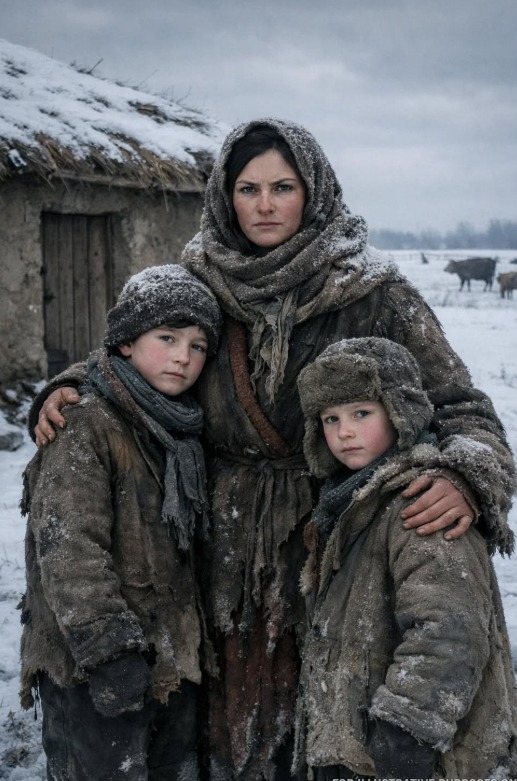
Greta was still sleeping under a blanket, with one hand tucked under her cheek.
Fritz sat on the bottom bunk with a tin spoon in his hand and watched the men as boys do who have already learned that adults can change a room simply by walking in.
Hinrich touched the wall next to the window.
Then he crouched down and touched it again, lower down, as if perhaps from another angle it might seem less real.
You buried it in the ground, he said.
Two feet, I replied.
And the walls?
Two feet thick where I could make them.
Thicker on the north side.
He nodded slowly.
It was a smart move.
Silas finally found his voice.
So what were you doing with that glass?
I looked at him. It was all I could afford.
He glanced at the children, then at the shelf, then at the stove, and the air of superiority I had noticed in him the previous week was gone.
In its place was something I liked much more.
A respect he didn't expect to receive.
Outside, the wind still blew across the prairie in long, cold gusts, but inside my little house it seemed far away, as if the earth itself had come between us and the elements.
That morning, men who expected to see failure stood on my doorstep and stared at the test.
Afterward, depending on how generous their mood was, people called it "the two-dollar shack," "the straw house," or "the widow's hole."
But the truth is simpler than that.
It was a rammed earth house.
And I built it because there was nothing else to do.
Three months earlier, I had arrived in Custer County with my husband, a wagon, two children, and the kind of hope people mistake for a plan.
Carl and I had talked about that dream in hushed tones for almost a year before we left West.
A land all ours. A right on which no landowner could raise the rent.
A land that could one day belong to Fritz and Greta, if only we could survive long enough to transform it into something more than just grass and wind.
We had talked about fruit trees as if it were possible to make them magically appear in a place.
About a porch. About chickens.
Imagine a real table by a window where our children would learn to read.
In the light of a lamp, dreams seem solid.
Their sound changes after a man discovers how much work they require.
Carl moved towns somewhere between the Missouri and the Platte River.
He didn't say it openly.
Men like him almost never do that.
It emerged first in silence.
So he stopped looking at the map and began staring resentfully at the horizon.
The way he counted our money every night, but never the miles we'd already driven.
In the way he addressed the children, he was less kind when they were hungry or tired.
As we approached our property, he was already mentally leaving.
One morning I woke up before dawn and found the space next to me empty.
The workhorse was gone. And with it, the wad of money we kept wrapped in a cloth under the seat.
He took his rifle, his spare shirt, and his best boots.
There was no ticket.
Only its outline is missing.
Generated image
For an hour I sat there in the wagon with both sleeping children and felt like the world was shrinking around me.
The sky was clearing in the east.
The grass turned silver in the dawn wind.
I remember hearing Greta turn over in her sleep and say something soft and meaningless, and the ordinariness of that sound almost broke my heart.
Because children will wake up even when your life has fallen apart.
They will ask for breakfast.
They'll be cold.
They will need your help to make the day run smoothly.
So I did what women have always done when pain hits during a workday.
I got up.
Now there was nothing left but the claim.
I could try to head back east with two children, an old wagon, and almost no money, or I could stay and fight nature to find shelter before the weather worsened.
By the third day, I realized the prairie had made the choice for me.
The distance alone had trapped us there.
There was nowhere to run that didn't also pose a threat of death.
That's when Hinrich arrived.
He was not a bad man, but the kindness typical of the frontier was practical, otherwise he was worthless.
He reviewed the request and gave me a verdict, not a consolation.
There are no suitable trees to build a cabin.
No team to cut and haul the timber.
I don't have the money to buy enough wood.
To build a proper turf house, a team of plows was usually needed to cut thick, clean, and fast strips.
I had at my disposal a spade, an axe, a child's tin bucket, and two little helpers with more love than strength.
Sell the deposit, he told me.
Go while you still can.
He wasn't kidding me.
This made things more difficult.
Because if even an honest man had thought we were going to die there, what exactly was I fighting against if not fear and stubbornness?
That night I drew in the dirt until the moon rose.
A smaller house would require fewer blocks.
A lower house would require fewer walls.
If I buried it partially, the soil would insulate us and I would reduce the amount of material I had to stack.
The wagon provided me with planks to build bunks and shelves.
The stove gave me a reason to aim for compact space rather than comfort.
Everything would have to earn its place.
The answer came from the roots.
The prairie doesn't grow the same way the eastern lands grow.
The grass anchors itself to the ground forming strong woven mats.
When I dug the spade deep and lifted it up, the earth came out as a block, held intact by the roots.
Once I saw it, I couldn't stop seeing it.
The earth had already produced bricks.
He had been producing them under my feet for years.
The cost I incurred was that of labor.
Days and days.
I started before dawn because it was easier to work the soil before the sun hardened it.
Each block had to be cut, detached, lifted and dragged to the pit where the house would be built.
First I demolished the floor, then I built the walls upwards, staggering each piece like a brickwork.
The dirt under my nails has become permanent.
At night my shoulders hurt so much that I had to use both hands to lift a cup.
The first week I cried only once, and only once.
Not because of work.
Because a brick fell on my foot, I sat down heavily on the grass and realized that there was no one to talk to in an adult voice.
No one can say I'm tired.
No one can say I'm afraid.
No one can say that I resent the man who made all this possible by walking away.
Then I buried my face in my apron and cried for less than a minute.
Then Greta came carrying a clod of earth she could barely hold, and I wiped my face before she could see it.
In those weeks Fritz took a more serious attitude.
Children change faster when no one has time to shield them from what life means.
He stopped asking when his father would return.
He gathered willow branches from the stream, collected dung for fuel, carried water in a bucket that hurt his shins with every step, and looked at me the way adults look after a funeral.
Greta remained a four-year-old throughout this entire period.
He hummed to himself. He named the grasshoppers.
He thanked the house every time another wall was built.
To learn more, see the next page.