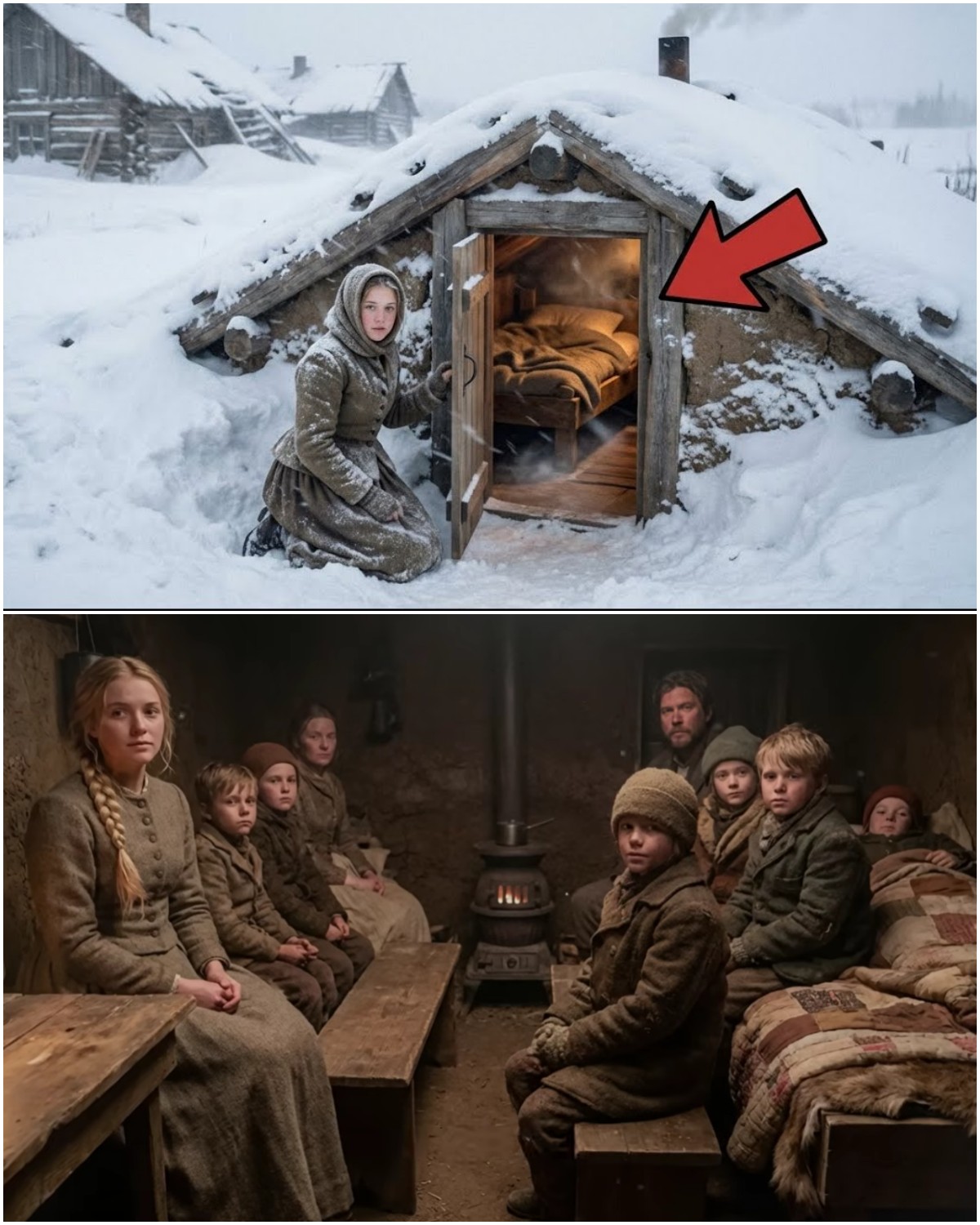
That memory gave structure to his plan. He would build a hut, but not just a pit. He would build one with an innovative heating system based on the same principle his father had demonstrated. A cooking fire in one area would channel exhaust fumes through clay channels buried beneath his sleeping platform, before the smoke finally escaped through a chimney.
Find out more
Heated beds
Energy efficiency
Snow forecast
The hot smoke would warm the clay tiles and the surrounding earth. The accumulated heat would then rise to her sleeping quarters. This way, she could have a warm bed and floor thanks to the same fires she used for cooking anyway. She wouldn't be burning additional fuel just for convenience, but would be capturing and redirecting energy that most people let go. Constructionhouse
She found an unclaimed plot of land 6 kilometers from Elhorn, a plot no one wanted because the soil was poor and the area isolated. There, she filed a claim for unauthorized occupation, knowing that at 15, she could occupy and improve the land, but she couldn't yet obtain legal ownership of the land, something that immediately eluded her at 21.
Find out more
Outdoor floors
Secret hideaways
Floor installation
However, ownership and improvement mattered, and the claim gave her a starting point. With her $9, she bought what mattered most: a good spade for $2.
He bought clay drainage pipes for $3, the same type farmers used to drain wet fields, because they would be perfect as gutters. He bought a small iron cooking grate for $1. The last $3 went towards basic food supplies. It wasn't a generous budget. It was just enough. Mattresseswarm up
He began excavating on September 1st. The pit he had designed was to be 4.27 meters long and 3 meters wide, covering a total of 13 square meters. It was small for one person, but sufficient if planned correctly. He dug to a depth of 1.52 meters, intending to create an underground chamber with earthen walls and an earthen roof.
The work was exhausting from the start. The Nebraska prairie grass was thick and difficult to work, its roots woven into a dense layer that resisted cutting like woven fiber. He had to cut it with the edge of the spade, breaking up chunks and removing them one by one.
Find out more
Heating solutions
Snow clothing
Orthopedic beds
Beneath the turf lay a sandy-loamy soil, easier to dig but still exhausting to lift and carry. Each shovelful meant filling the spade, climbing out of the hole, dumping the earth on the expanding perimeter, climbing back down, and starting over. The work was repetitive, arduous, and solitary. Panelshouse radiants
Progress came only in small steps, with great pain. Her hands became covered in blisters within a few days. Her back ached constantly from the constant bending and lifting. Her shoulders burned from the repetitive motion of cutting, levering, lifting, climbing, unloading, and lowering again.
Yet the pit continued to deepen. From 30 cm, it went to 60 cm, then from 60 cm to 90 cm, and by the end of September, it had dug the full 150 cm, creating a rectangular space measuring 4.2 x 3 meters. The dimensions were not random. Every 30 cm mattered, because every 30 cm affected the amount of air to be heated, the span of the roof it would have to support, and where to install the heating system. Weather forecast
This heating system was the crucial element, and its construction required a degree of precision that would determine the success of the entire underground shelter. Before building the sleeping platform or covering the structure with a roof, he had to install underground exhaust pipes that would convey the hot smoke beneath the sleeping area.
Find out more
Beds and headboards
Floor maintenance
Winter sports
This wasn't something she could improvise later. If she made mistakes now, the system would fail when the cold weather arrived, and she didn't have the money to replace the wasted materials.
He carefully chose the spot for the cooking fire. It would be in the northwest corner, a small hearth about 60 centimeters square, where he could prepare his meals. The location had been carefully planned. Equipmentsnow
The location in the northwest corner meant that prevailing winds did not blow directly into the hearth opening, and smoke was also naturally conveyed through the pit to the opposite corner, where the chimney stood .
The clay drainage pipes he purchased were standard agricultural pipes, each 6 inches in diameter and 12 inches long. He bought 20 of them for $3, enough to make a 14-foot channel with spares left over in case a section broke or needed repairs later.
He placed the first tile where the combustion chamber would be located, sloping it slightly downward, perhaps about 2.5 cm over a 30 cm length. This slight slope was important. If the smoke had to rise through the underground flue, it would have cooled too quickly, losing the necessary efficiency. If the flue had been perfectly horizontal, the draft could have been weak or irregular. Heating,ventilation and air conditioning
Find out more
Home security
Smart thermostats
Fireplaces and stoves
A slight downward slope would encourage the smoke to flow, while also maintaining prolonged contact with the clay. He placed each tile next to the other with meticulous care, creating a continuous passageway throughout the future sleeping area.
At each joint, he sealed the connection with clay mud, not with store-bought mortar, because he couldn't afford it. He mixed local clay with water and a little sand. What mattered wasn't elegance, but watertightness. The joints had to be airtight enough to allow the smoke to continue along its intended path, rather than disperse needlessly into the surrounding soil.
The underground canal ran from the corner of the fireplace, below where he planned to build his sleeping platform, to the opposite end of the den, for a total length of 4.2 meters. At the opposite end, the canal would have connected to a vertical shaft made of stacked sod blocks. Heatingon the floor
The buried flue alone wouldn't have been enough. The draft needed an outlet. The chimney would convey the smoke to the outside, and the long horizontal section before that outlet would be where the useful heat exchange would occur.
He also realized that the tiles couldn't simply be buried under a loose weight. If he threw earth directly on them, the pressure could crack the clay. So he placed flat stones on top of the tiles to form a protective layer. He then covered this layer with 20 centimeters of compacted earth.
This layer of earth served several functions simultaneously. It protected the canal. It created thermal mass capable of absorbing and storing heat. Furthermore, it formed the substrate on which the sleeping platform would be built. Materialsand construction supplies
Above the buried tile trench , he built the platform itself. It was raised 30 cm above the surrounding floor, so that his sleeping surface was elevated and directly above the warmest section of the system. He used salvaged poplar planks to construct a platform 1.80 m long and 1.20 m wide, enough space for a single person.
Between the compacted earth above the tiles and the underside of the platform, he had placed river rocks collected from a stream three kilometers away. This meant repeated trips, perhaps twenty in all, carrying rocks in a cloth sack. In total, he may have moved about 135 kg of rocks by hand. Heating,ventilation and air conditioning
The purpose of this work was simple: stone retains heat. If the buried tiles heated the earth, and the earth heated the stones, the latter would continue to emit heat long after the fire had gone out.
The platform's surface had to fulfill two functions simultaneously: it had to support its weight and allow heat to rise. Therefore, he arranged thin planks on the structure, leaving gaps of about half a centimeter between them.
These spaces would allow heat to spread upward, while also making the surface usable as a bed. He would spread blankets over the planks. Beneath them, the empty spaces, the heated stone, the compacted earth, and the underlying chimney would make his sleeping area the warmest part of the trench.
Before winter arrived, he needed concrete proof, beyond memories and hopes, that the idea worked. In mid-October, he tested the system for the first time. He lit a small fire in the fireplace using perhaps three pieces of wood, weighing no more than a kilo in total. Heatingon the floor
Then he looked. Smoke was coming in through the gap in the tiles. He approached the chimney outlet and held his hand near it. Hot smoke was rising from it, which meant the draft was working and the underground flue was conveying the fumes exactly as intended. After two hours of burning, he climbed onto the sleeping platform and rested his hand on the boards.
They were remarkably hot, perhaps 80°C. The heat had spread from the fire to the chimney, from the chimney to the clay, from the clay to the surrounding earth and stones, and from there upward through the bed frame . The system worked exactly as his father's experiment had predicted.
By early October, the burrow's structure was complete. The excavated room had earthen walls, but these needed reinforcement and insulation. He cut sod into blocks and stacked them against the interior surfaces, both to stabilize the soil and to enhance the insulation.
For the roof, he placed poplar poles across the span and covered them with grass and sod. From above, the finished structure would appear modest, almost invisible, more like an embankment than a house. Mattresseswarm up
The entrance consisted of a sloping ramp descending into the pit, a form easier to construct than a staircase and useful for another reason as well. The low entrance acted as a trap for cold air. The cold air descending from the ramp accumulated there instead of flowing immediately into the main interior space.
The fireplace also had to be carefully constructed. He surrounded it with stones for safety. The opening had to be positioned so that the smoke would be drawn into the underground pipe system rather than venting into the room. At the point where the fireplace joined the pipes, he sealed the joint as carefully as possible. Any leak at that point would have ruined the entire project, venting the smoke into the cellar instead of through the heating duct.