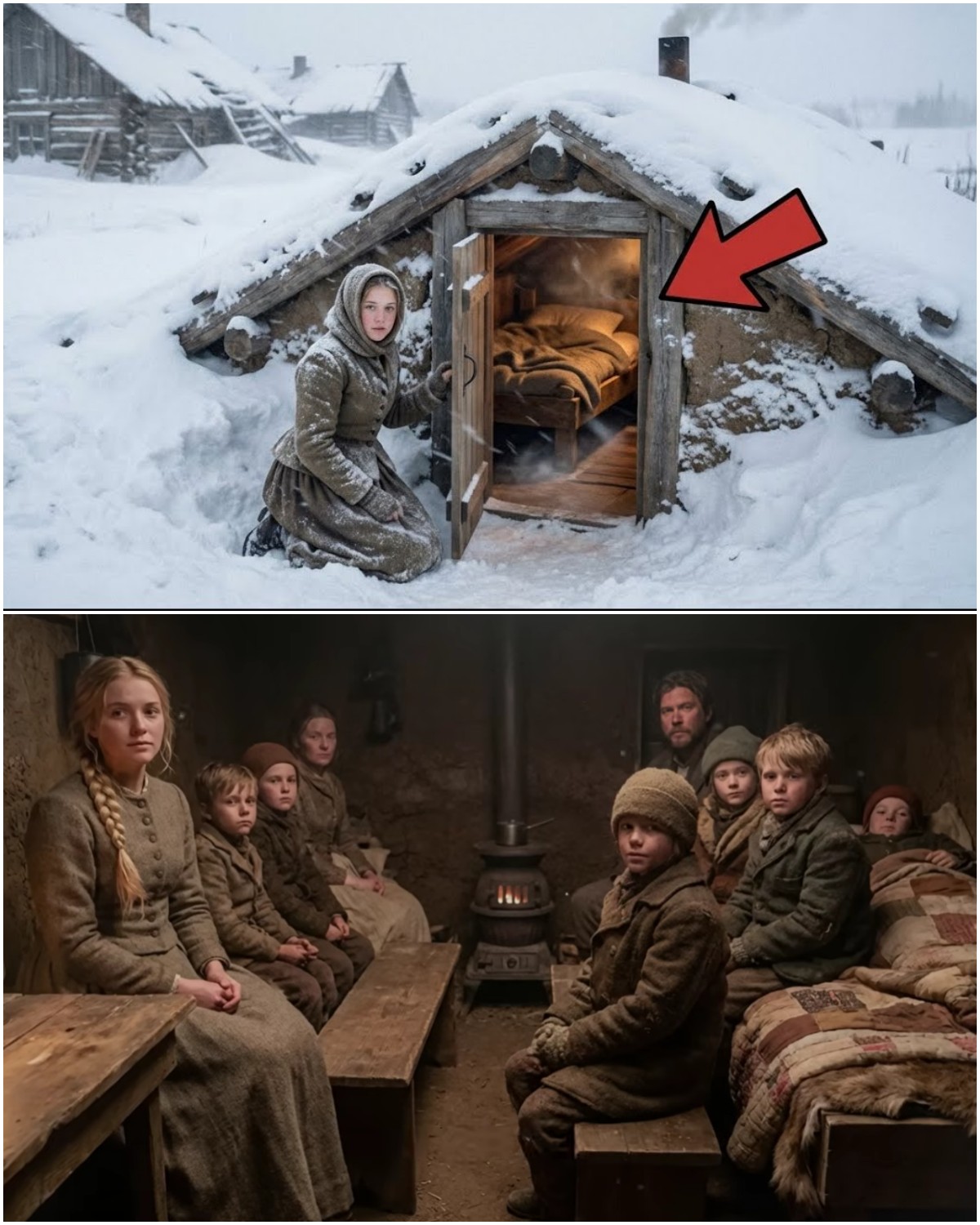
By mid-October, he was living underground. The space was dark. Daylight filtered in dimly from the ramp, and at night, he had only candlelight. Yet the underground shelter was dry and, more importantly, unexpectedly warm. Even without a fire, the surrounding soil kept the internal temperature around 10°C.
That level of comfort wasn't luxurious, but it was stable, and in winter, stability is a form of wealth. When she cooked, the chimney did the rest. Smoke passed through the 15-foot-long brick flue, heating the clay to about 200°F (93°C). The heat spread outward, into the earth and stone.
The platform on which he slept heated up considerably, perhaps reaching 70-80°C in the hottest spots. After he finished eating and tidied up the coals, the heat persisted. For six to eight hours after the fire went out, the floor beneath his bed continued to radiate heat upward.
What he had created wasn't simply a shelter. It was a system. He used waste heat from cooking, heat that most families let escape through the fireplace, to warm their sleeping quarters.
Find out more
fireplace
Stoves, hobs and ovens
Heating, ventilation and air conditioning
The system cost her nothing beyond the initial tile installation. It required no additional fuel beyond that needed to prepare the food. By combining underground insulation, stored thermal mass, and exhaust gas recirculation, she had achieved a level of efficiency that no one around her could fathom.
When the town learned how she lived, the immediate reaction was one of ridicule. The Larsen girl, everyone said, lived in a hole in the ground. She had buried clay tiles as if imagining herself in an ancient Roman villa, but in reality she simply lived in the earth.
Everyone knew that the huts dug into the prairie were death traps. Everyone knew that, come true winter, the ground would turn into a freezing tomb. Her elaborate explanation of buried drainage ditches and heated floors didn't strike them as intelligent reasoning, but rather the rationalization of a girl too stubborn to accept reality.
In November, Pastor Henrik of the Norwegian Church arranged a visit. He came with five church members to convince Ingrid to accept what they considered adequate help: a decent job, decent housing, and a place in a respectable family.
Descending the access ramp, they found themselves in the dark interior of the den and paused for a moment, while their eyes adjusted to the darkness. They saw rammed earth walls covered with turf. They saw the crude sleeping platform. They saw the small fireplace and the clay tiles that extended beneath the floor. The space looked primitive. It looked poor. To them, it seemed not a test of ingenuity, but of suffering.
Find out more
Beds
Mobile
Home furniture
"My son," Pastor Henrik said softly, "you live underground like an animal. This den isn't properly heated. I see your little fire, but it won't be enough to warm this place in January. You must accept the Johansson family's offer. They need help in the kitchen. They're offering room and board, and a dollar a month. Now that's decent work." Articlesfor the kitchen and dining room
"The cabin is heated," Ingrid replied. "The tiles under my sleeping platform absorb the exhaust heat from the cooking fires. The smoke warms the tiles. The tiles warm the floor. I sleep warm. It's more efficient than traditional heating."
For them, it wasn't proof, but further evidence of self-deception. The clay pipes buried in the ground, Pastor Henrik replied, weren't a heating system. They were desperation. When the temperature reached -20 degrees, she would freeze to death in that hole.
They urged her to accept help before it was too late. Ingrid had already learned one of the hardest lessons of addiction: there's no point in arguing with people who are certain they understand your situation better than you do. So she thanked them for their concern, listened unwaveringly, and watched them leave, fully convinced that in their eyes, she would be dead by Christmas.
Find out more
fireplace
Stoves, hobs and ovens
Weather forecast
Part 2
Throughout November, the underground shelter proved not only livable but actually functional, and Ingrid developed routines that made life underground orderly, efficient, and, given the circumstances, almost comfortable. Outside, nighttime temperatures dropped to -7°C, and by the end of November, they were approaching -12°C.
Inside, the temperature of the den remained constant at around 50°C even without her doing anything to heat it. This fact mattered more than any ironic comparison between houses and holes in the ground. The earth itself acted as insulation.
She wasn't trying to lift a fragile wooden structure from a 20°C outside temperature to a habitable interior. She started each day with an outside temperature of 50°C already present on all sides. To reach a comfortable temperature, she simply added a small amount of heat.
His daily routine revolved around this advantage. In the morning, he woke up on the platform where he slept, which still retained some of the heat accumulated by the fire lit the previous evening. Even six to eight hours after the embers had died down, the boards under his blankets could still be around 60°C, a perceived temperature significantly higher than that of the rest of the hut.
Find out more
Heating, ventilation and air conditioning
Bed
Beds
He would get up, light a small fire, and use perhaps two or three pieces of wood to cook a cornmeal porridge. As the fire burned, the smoke would penetrate the buried tiles and heat them again, perhaps up to 150°C (300°F). The clay and surrounding earth would absorb the heat.
The stones under the bed absorbed the heat and released it. Within 30 minutes, the platform could reach 70°C. She ate breakfast sitting in the warmest spot in the shelter, the temperature around her body made bearable not by whim, but by careful planning. Bedsand headboards
The same logic governed the evening. She would build a slightly larger fire for the last meal of the day, perhaps with four or five logs to cook beans, potatoes, or whatever other food she could find. The smoke passing through the underground system would heat the tiles more intensely, perhaps to 200°C or more.
That intense heat transferred to the earth and stones and remained there even after the visible flame had died down. By the time he had finished eating and gathering embers, the platform could reach 80°C, not only cooler than the room, but decidedly warm.
Then she'd sleep through the night as that heat slowly decreased: perhaps 180°F at 9 p.m., 160°F at midnight, 140°F at 6 a.m. In the morning, her core temperature would return to near its baseline 120°F, maintained by the earth, and she'd begin the cycle again. What she'd created wasn't a one-time trick, but a repeatable daily rhythm in which cooking, heating, and sleeping formed a single, integrated pattern.
The system's efficiency was equally astonishing. Its total fuel consumption was probably around 6 or 7 logs a day, perhaps 2 cords for the entire winter. For comparison, her aunt's family consumed about 8 cords of wood in a winter and still struggled to adequately heat their home, built using traditional methods.
The difference wasn't that Ingrid had discovered some magical source of heat inaccessible to others. It was that she had changed the relationship between heat generation, dispersion, and storage. Others produced heat and let much of it dissipate. She produced less, but stored more.
December brought such cold that it put every claim to the test. The temperature dropped to 0°C and remained there for days. Ingrid's burrow wasn't a pleasant place by modern standards, but it didn't give in. It maintained its base temperature of 50°C because the ground temperature 1.5 meters below ground didn't fluctuate with every gust of winter air at the surface.
His cooking fires, no larger than before and no longer using wood, still heated the tiled floor. He slept warmly above the underground canal, while the prairie above froze under a harsh winter sky. The difference between survival and suffering often lies not in abundance, but in what remains constant when everything else changes. His underground refuge was synonymous with perseverance. Articlesfor the kitchen and dining room
Then, on December 14th, the blizzard arrived.
It arrived with a force that veteran Nebraska settlers immediately recognized as potentially lethal. The temperature dropped steadily to -25°C. Winds blew across the land at 70 miles per hour nonstop.
Snow fell at 3:00 a.m. and was hurled sideways by the storm, completely obliterating visibility. The world above ceased to be a landscape and transformed into a shifting wall of white and noise, a chaos of ice and air where direction, distance, and judgment could vanish in minutes. The sound of the storm was a continuous roar.
Ingrid, 1.5 meters underground, with 1.2 meters of earth above her ceiling and earthen walls around her, experienced the storm differently. She perceived it as a distant, muffled violence. The roar propagated through the ground like a vibration rather than an immediate assault. She could sense subtle variations in pressure. Weather forecast
From the sound and the force transmitted through the ground, he knew the weather had become stormy above ground. But the storm didn't penetrate deep underground.
The access ramp filled with snow, which, far from dooming her, helped further insulate the shelter by preventing cold air from penetrating inside. She was effectively sealed in her underground chamber with enough food to last several days and a heating system that didn't depend on staying calm during the weather.
He cooked as usual. A small fire in the hearth sent smoke through the buried tiles. The tiles heated, the earth heated, the platform heated. The heating behaved exactly as it had before the blizzard, because the laws of physics at play remained the same regardless of the wind on the surface. His system was protected by being underground and by using stored heat, rather than relying on the constant production of large amounts of external heat. Mobilefor the house
Otto Schmidt's house, built above ground, was not similarly protected, and after six hours of stormy weather, it was already in dire condition. The wind pushed frigid air through every crack in the structure. The thin wooden walls offered little resistance to the prolonged -25°C (-13°F) cold.
They constantly fed the stove with wood, desperately trying to maintain heat, rekindling it every 30 minutes and burning fuel at a rate no family could sustain for long. Yet the stove couldn't compensate for the heat loss. At midnight, 12 hours after the storm began, the temperature inside the house was only 42°C (108°F), despite this frenetic use of the stove.
Otto's children were wrapped in every piece of clothing they owned. They sat wrapped in blankets right next to the stove, still shivering. The youngest, Anna, four years old, began to show the first symptoms of hypothermia: lethargy, confusion, and a grayish complexion.
The house was still standing, but a standing house isn't the same as a functioning shelter. By dawn on December 15th, the second day, the situation had become desperate. Inside, it was 38°C (98°F). Half the winter's firewood had been consumed in just 24 hours.