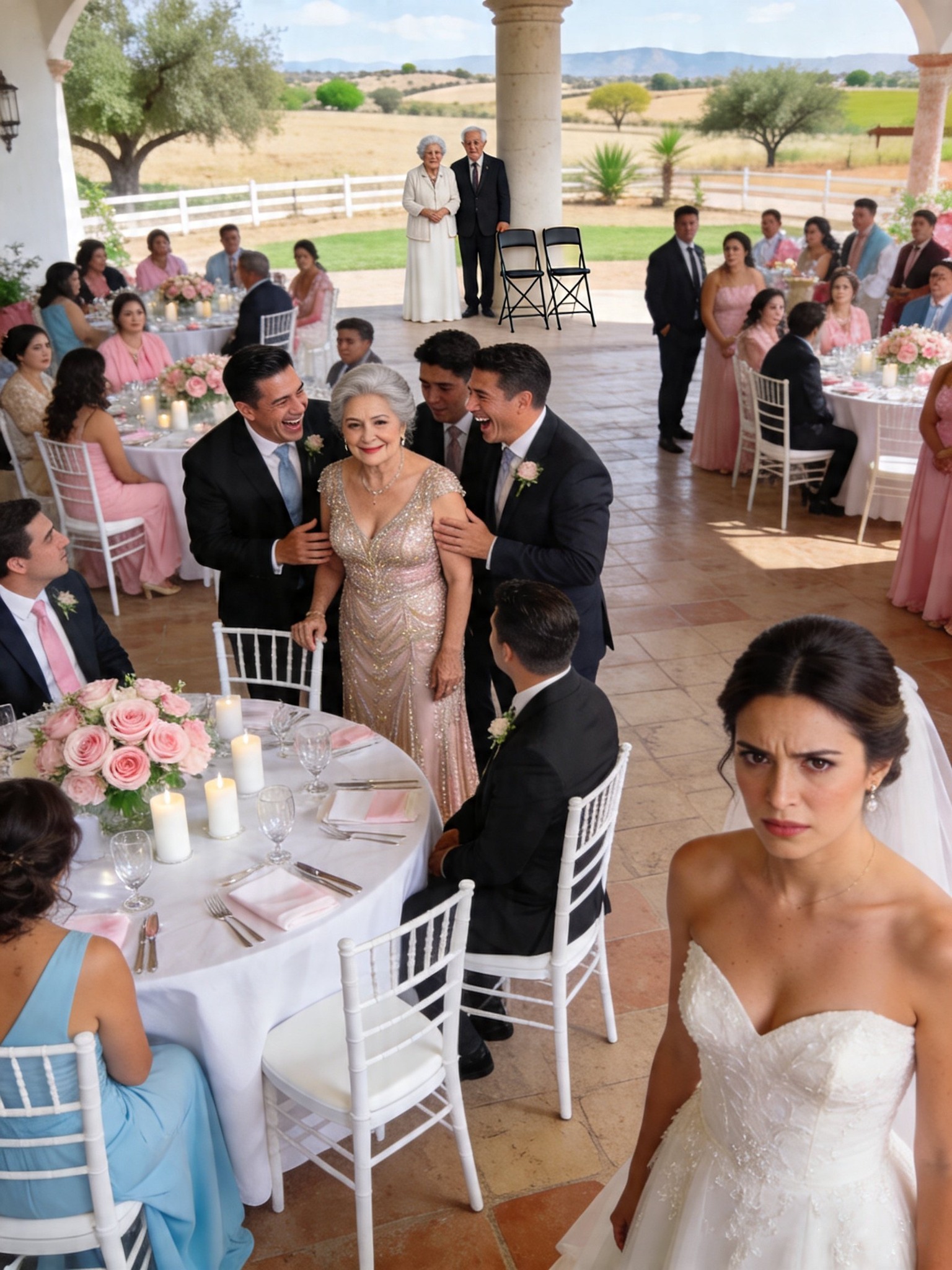
Just fifteen minutes before the wedding, I discovered the newlyweds' table had been changed: nine seats for my husband's family, with my parents standing off to one side. His mother snorted, "They look pathetic." So I grabbed the microphone... and destroyed it instantly.
The ceremony was to take place at a hacienda outside Guadalajara, adorned with bougainvillea, soft lighting, and a white tent where a string trio was already playing. I was in the private room, finishing putting on my grandmother's earrings, when Mariana, my cousin and godmother, entered without knocking. She looked pale.
—Sofia, you have to come right away.
I didn't like her tone. I stood up, gathering my dress in my hands, and followed her down the service corridor to the ballroom. As I entered, I saw three waiters shuffling the cards on the main table. I thought it was a last-minute change, but then I read the names.
To the right of Diego's seat: Patricia and Roberto Mendoza, his parents. Then his sister, his brother-in-law, two uncles, and three cousins. Nine seats. Nine.
I looked up my parents' names.
They weren't there.
I turned and saw, a few meters away, two folding chairs positioned next to a side column, not even facing the table. No elegant tablecloth, no flower arrangement, no sign. As if they were obligatory extra guests.
"What is this?" I asked.
The event organizer swallowed hard before answering.
—Mrs. Patricia requested the change this morning. She said it was a family decision and that she had her fiancé's approval.
I felt a strong blow to my chest.
—The boyfriend's approval?
—That's what he said.
At that moment, Patricia, my future mother-in-law, appeared, impeccable in her dark green dress and with a sharp smile that never reached her eyes. She glanced at my parents' chairs and then looked at me.
—Don't be so dramatic, Sofia. Your parents can be there just fine. After all, they're not used to this kind of environment.
The blood was pounding in my ears.
—It's my wedding.
She gave a short laugh, loud enough for the waiters to hear.
"And my son's too. The groom's family should be visible. Your parents... well"—he shrugged—"How pathetic they look trying to fit in here."
I don't remember breathing after that sentence. I only remember seeing my father, from the doorway, wearing the suit he'd paid for in installments over the months, and my mother adjusting her purse as if she hadn't heard a thing.
I asked about Diego. No one could tell me where he was.
And then I realized something terrible: if he'd allowed it, he wouldn't have just displaced my parents. He was showing me, even before we were married, the exact place I would occupy in his life.
I saw the microphone positioned for speeches, next to the lectern decorated with white flowers.
I walked towards him.
Mariana tried to stop me, but it was too late. I took the microphone with a steady hand that didn't feel like my own, turned toward the room filled with guests who were beginning to take their seats, and said:
—Before this wedding begins, there's something everyone deserves to hear.
The first sound that came out of the microphone was a faint whistle. The second was silence.
Not the elegant silence of a luxury reception, but the tense silence that pervades a room when everyone senses something is about to explode. The musicians stopped playing. The waiters remained still. I saw several heads turn simultaneously, first toward me and then toward Patricia, who remained motionless at the head table, her lips compressed.
I took a breath. Just one.
"I want to apologize," I said, "to my parents, who were humiliated before their very eyes today at their daughter's wedding."
An immediate murmur spread among the empty tables and the guests already entering from the garden. I saw my mother raise a hand, silently asking me to stop. My father didn't move. He had that impassive expression he always wore when he was making a tremendous effort to maintain his dignity.
—Less than five minutes ago, I discovered that the head table had been changed without my consent. Nine seats had been reserved for my fiancé's family. My parents had been pushed aside, practically standing, as if they'd been done a favor by being admitted.
The event organizer lowered his gaze. I continued speaking.
—When I asked why, I was told that Mrs. Patricia Mendoza had assured me that this decision had the groom's approval.
At that precise moment, Diego appeared from the side entrance. He was coming from the parking lot, his tie loosened and his cell phone still in his hand. When he heard his name and saw me standing at the lectern, he paled.
“Sofia, put it down right now,” he said, walking quickly towards me.
I ignored it.
—And when I asked about it, the groom's mother looked at my parents and said, literally, "You look so pathetic."
There were no more murmurs. There was something worse: expressions. Gestures. People turning to look at my parents. People staring at Patricia as if, for the first time, they were really seeing her.
"That's not what I meant!" he exclaimed.
“You said it,” I replied without shouting. “In front of witnesses.”
Diego was already near the lectern.
—You're putting on a show.
I looked at him for the first time since I picked up the microphone.
—No. You're the ones who organized this show.
There was such a heavy silence that I heard someone placing a glass on a tray.
"I'll ask you a very simple question, Diego," I continued. "Did you know they'd changed the table?"
He stared at me for two seconds. Then for a second. Finally he looked away and at his mother.
And he didn't answer.
That was a complete answer.
I felt a strange calm. Like when a fever goes down and the body stops fighting the obvious.
“I understand,” I said.
I stepped down from the podium without letting go of the microphone. Diego tried to grab my arm, but Mariana stepped between us.
“Don’t touch her,” he said.
My aunt Veronica, who had been standing aside until then, rushed to my parents. My mother was crying. My father was still motionless, only now his jaw was stiff. I wanted to join them, but I had to finish first.
I picked up the microphone again.
—Since many of you have traveled from Mexico City, Monterrey, Puebla, and Querétaro to be with us, you deserve to know the whole truth. This isn't the first time something like this has happened.
Patricia stepped forward.
-Enough.
—No —I said—. Not anymore.
And I continued.
I explained how, from the moment the engagement was announced, every decision had to be filtered by his mother. The dress was "too simple." The menu was "too crude." The guest list was "too full of irrelevant people." I explained how she suggested changing the music because my family "wouldn't know how to handle an elegant repertoire." I explained how she wanted to remove the homemade chiles en nogada from the menu because she deemed them "too simple for a wedding," even though it was my late grandmother's recipe and Diego knew exactly what it meant to me. I also explained how, two weeks earlier, Patricia had told me during a private lunch that a woman who marries a man like her son must learn "her place."
As he spoke, he wasn't looking at people. He was looking at Diego.
Because the most painful thing wasn't Patricia. She never had been. What was unbearable was remembering all the times he'd been there and chosen silence. All the times he'd told me, "Leave her alone, you know how she is." All the times he'd asked me for patience, understanding, caution... always from me, never from her.
"I didn't want to do it today," I continued. "The last thing I wanted was to ruin this day in front of everyone. But there's a difference between an imperfect wedding and public humiliation. And I have no intention of getting married on a day when my parents are treated like they're a disgrace."
A collective gasp was heard. In the background, one of Diego's cousins put a hand to her mouth.
He finally reacted.
—You can't be serious.
-I am.
—You're nervous. We'll talk about it privately later.
I laughed. A short, incredulous laugh, one that even I didn't recognize.
—That's exactly the problem, Diego. Always later. Always in private. Always me keeping it to myself so as not to upset your mother, your uncles, your family name. Well, now it's over.
Patricia walked forward with her finger raised.
—If you annul this marriage now, I assure you that you will never marry my son.
I looked her straight in the eyes.
—Madam, you just told the only useful truth of the entire afternoon.
Then I turned to face the guests, my heart pounding so hard it hurt my ribs.
—The marriage is annulled.
That's where everything changed. And what happened next was even more unexpected than anyone in that room could have imagined.
Part 2…
This time the silence was absolute.
Then, everything happened at once.
Someone exclaimed, "Oh my God!" The coordinator put both hands to her head. My mother burst into tears. My father finally approached me. Diego began repeating my name over and over again, first softly, then louder, as if repeating it would give him back control of the situation.
I got down from the lectern and went straight to my parents.
My father grabbed my face with both hands.
"Are you sure?" she asked.
He didn't ask for money, or shame, or people. He asked for me.
And in that moment I realized that even though I had just lost a wedding, I hadn't lost the most important thing.
—Yes —I said—. Now yes.
What happened next wasn't cinematic. It was worse. It was real.
There was no dramatic music, no spontaneous applause, no triumphant exit among the admiring guests. There was confusion, tears, last-minute phone calls, an entire estate trying to figure out whether to serve cocktails, pick flowers, or call security. Family members on both sides assumed invisible positions. Some approached out of genuine concern, others simply to gain a clearer picture of the scandal.
I sat on a chair in the hallway for five minutes because my legs were suddenly shaking. Mariana took the microphone from me and gave me some water. My mother continued to cry, but it was no longer a cry of humiliation, but a cry of liberation. My father remained by my side like a silent wall.
Diego appeared before us accompanied by his father, Roberto, who had a red face and the expression of a man who only cares about the material damage.
"This is madness," Diego said, crouching down in front of me. "Sofia, look at me. We can fix this. We'll remove whoever needs to be removed, put your parents back in the spotlight, apologize, and move on."
I looked at him with a newfound serenity. The serenity you feel when you no longer expect anything.
"I don't want to move chairs," I replied. "I want a life where no one has to remind me that my parents deserve respect."
—My mother made a mistake.
—Your mother did what she always did. The difference is that today you can no longer pretend not to see it.
He squeezed his eyes shut, frustrated.
—You can't throw everything away for just one sentence.
My father spoke for the first time.
—It wasn't a single sentence. It was years of going along with it.
Diego jumped up. Perhaps he was surprised that my father, a man of impeccable manners, had intervened.
—With all due respect, this is a matter between me and Sofia.
“No,” my father said. “It stopped being an issue between you two when you tried to humiliate us in front of two hundred people.
I didn't know if it was those words or the firm tone, but Diego took a step back.
It was then that Teresa, Roberto's older sister and Diego's aunt, appeared. A sixty-year-old, elegant woman, known in the family for never holding back a word. She stopped in front of Patricia and said in a clear voice:
—You exaggerated.